

In This Article
- Our Hypothesis
- Our Methodology
- Acknowledgments
- Our Findings
- Demographics
- Key Takeaways
- Top 10 Conditions Individuals Are Seeking to Treat with Cannabis
- Top Conditions by Age Range
- Top Conditions by Region in the U.S.
- Putting Our Findings in Context
- Patient Needs Don’t Fit Cleanly Into Existing Categories
- Where Patients Live Shapes How They Access and Use Medical Cannabis
- Policy and Data Are Closely Linked
- Further Study Is Needed
- Benefits of Talking to Your Doctor
- Dosing Considerations
- Conclusion
For decades, medical cannabis has been surrounded by confusion, stigma, and mixed messaging. Because of this, many current and potential patients may feel like they have to figure things out on their own, without clear or reliable info about how cannabis fits into their care.
NuggMD’s 2025 Conditions Report looks at why patients are seeking medical cannabis today. This year’s data reveals a shift from our previous report of 2022 data: anxiety has overtaken chronic pain as the most commonly reported condition.
By highlighting key trends across conditions and demographics with anonymized data, we hope to bring more clarity to the conversation. Our goal is to help patients feel seen while giving clinicians, policymakers, and researchers a better understanding of why people choose cannabis.
Why Consider Data from the NuggMD Annual Conditions Report?
As the leading medical cannabis technology platform, NuggMD has connected over 2.5 million patients with state-certified medical marijuana doctors. As one of the first telehealth companies in the industry, we serve patients across more than half of the United States and internationally, including the UK and Germany, via our state-of-the-art telemedicine platform. This allows us to review hundreds of thousands of data points across dozens of states, audience demographics, and more.
Our core belief is that every human being has the right to explore the benefits of medical cannabis. That means providing access to the information, support, and licensed medical practitioners that patients need to understand and explore all their options on their journey to wellness.
This report was compiled using anonymized pre-evaluation and patient survey data from over 96,000 patients on the NuggMD platform between Jan 1 and Dec 31, 2025. Patients self-reported their age, gender, location, and reason for seeking medical cannabis.
Our Hypothesis
We set out to answer a few questions:
- What are the most common conditions nationally for which patients seek medical cannabis?
- Do patient age, gender, and location affect the reasons they seek cannabis?
- How does variance in qualifying conditions by state affect the way patients pursue medical cannabis?
- How does variance in qualifying conditions by state affect doctors’ ability to provide the best care?
We expected to find a significant difference in the conditions that patients seek to treat with medical cannabis based on age, self-identified gender, and geographic region (particularly based on what conditions qualify for treatment and receive the most focus in that specific state/region).
By supplementing our findings with additional research around regional policies, qualifying conditions, and existing data on the prevalence of these conditions and non-cannabis treatments, we can better understand why this variance exists and propose steps that states and organizations can take to improve information accessibility based on patient needs.
Our Methodology
We analyzed data from over 96,000 patients who signed up on NuggMD between January 1, 2025, and December 31, 2025, covering 12 months of comprehensive data. Patient data were collected from 31 states where NuggMD provides services, with ages ranging from 18 to 103.
Data were segmented into respondent groups based on self-identified gender (male, female, or gender_x), state of residence, and age, as recorded in pre-evaluation health records. This was done to assess whether gender, age, or geographic region correlated with higher or lower use of medical cannabis for specific conditions.
Supplemental research was conducted to support or refute findings for conditions that showed greater variance by gender, age, or region, as well as to understand patterns of patient cannabis use to help place our findings in a greater context.
Further research encompassing larger numbers of respondents across all age ranges and states, expanding to include in-person evaluation data, and controlling for demographic and ethnic variables, is required to validate or refute this data and provide the most accurate information for individuals, practitioners, and policymakers.
Acknowledgments
| Rachel Sims Report Author & Analyst Staff Writer, Editor, and Marketing Associate at NuggMD Freddy De La Mora Report Review VP of Operations & Customer Success at NuggMD | Dr. Brian Kessler Report Medical Review Medical Provider and Medical Reviewer at NuggMD St. George’s University School of Medicine | New York Medical College | Lincoln Hospital Medical Center | Residence in General Surgery Medical License in NY and CA Member of the American Medical Association (AMA) |
Our Findings

Demographics
This dataset includes 96,100 patients, and there are a few important trends to keep in mind when interpreting the findings.
- The population skews younger, with 38.5% of patients between ages 18 and 24 and nearly 70% under age 35.
- Gender is relatively balanced, though slightly male-skewed (59.5% male vs. 40.0% female).
- Geographically, responses are concentrated in the West, largely driven by California. Nearly half of all patients (48%) come from this region.
- A handful of other states, including Pennsylvania, West Virginia, and Oklahoma, are also contributing higher volumes than others.
Because of this, raw totals don’t always reflect national trends on their own. To get a clearer picture, we examined raw data across regions and compared how conditions manifest within each state’s patient population. This helps highlight where certain conditions are more common, rather than just where we have the most data.
Key Takeaways
- Anxiety is the #1 reason patients seek medical cannabis. Anxiety has overtaken chronic pain as the most commonly reported condition among medical cannabis patients, signaling a shift in accepted treatments and how cannabis is being used.
- Chronic pain still dominates, just not everywhere. Chronic pain remains one of the most common conditions overall, but drops sharply in the West, where anxiety, stress, and insomnia drive the majority of use.
- Over 20% of patients can’t find their condition on the list. More than one in five patients selected “Other” as their condition, suggesting many are unable to find an option that reflects their actual needs.
- Patients aren’t just treating one condition. Most medical cannabis patients report multiple conditions, suggesting cannabis is often used to manage overlapping symptoms rather than a single diagnosis.
- Mental health drives cannabis use in younger generations. Younger patients are far more likely to seek cannabis for anxiety, stress, and sleep issues, while older patients focus on chronic pain and long-term conditions.
- Some states show extremely concentrated patient needs. In some states, a single condition dominates patient use. For example, chronic pain accounts for over 70% of reported cases in Arizona.
Top 10 Conditions Individuals Are Seeking to Treat with Cannabis
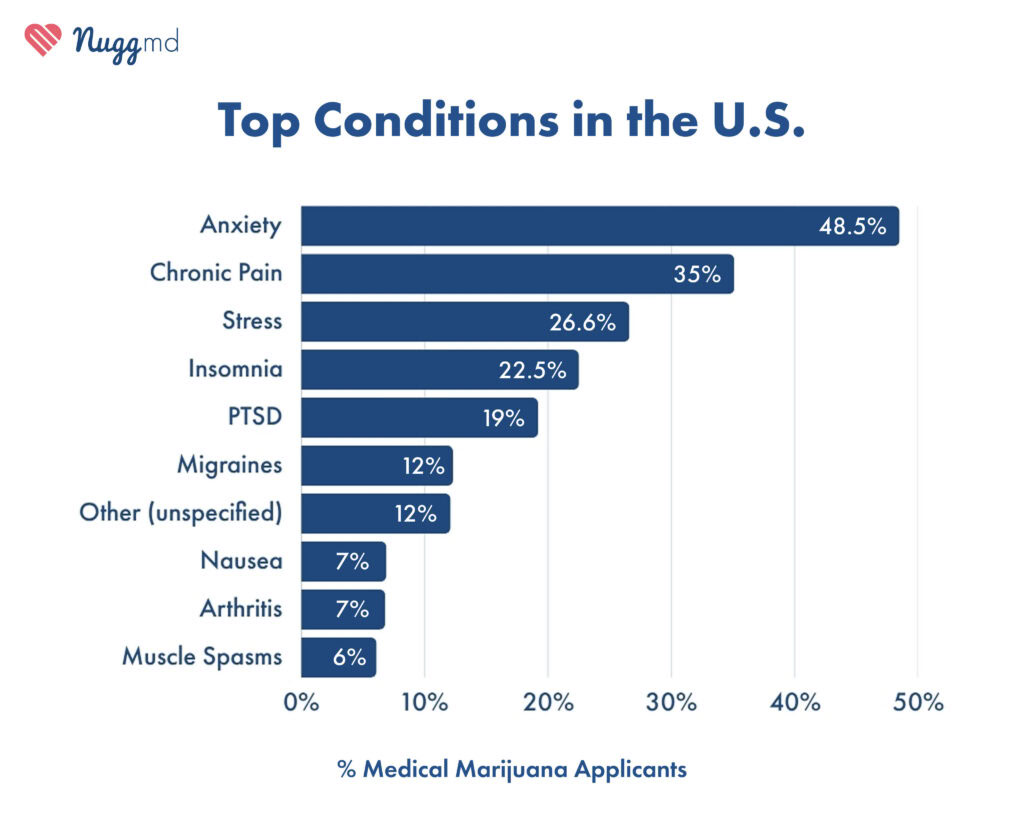
Pre-evaluation data shows that mental health concerns and chronic pain remain the most common reasons patients seek medical cannabis.
Anxiety is the most frequently reported condition, with nearly half of all patients (48.5%) indicating they are seeking support for anxiety-related symptoms.
Chronic pain remains a major driver, with more than one in three patients (35.1%) reporting it as a primary concern. When combined with related conditions like migraines, nearly 45% of patients report some form of pain-related condition.
Stress follows closely behind, reported by over one in four patients (26.6%). This may help reinforce the growing role of cannabis in managing day-to-day mental health challenges.
Sleep-related issues are also prominent. Insomnia affects over one in five patients (22.5%), often alongside anxiety or stress. Similarly, post-traumatic stress disorder (PTSD) is reported by 19.2% of patients, highlighting the overlap between mental health and sleep disruption.
Other commonly reported conditions include migraines (12.3%), nausea (6.9%), arthritis (6.8%), and muscle spasms (6.1%).These findings suggest patients are often seeking cannabis to manage interconnected issues, particularly across mental health, sleep, and chronic pain.
| Top 10 Conditions Individuals Used Cannabis to Treat in 2025 | ||
| Conditions | Total # of Individuals Seeking Cannabis for the Condition | % of Total Submissions |
| Anxiety | 46,599 | 48.5% |
| Chronic Pain | 33,741 | 35.1% |
| Stress | 25,588 | 26.6% |
| Insomnia | 21,642 | 22.5% |
| PTSD | 18,473 | 19.2% |
| Migraines | 11,818 | 12.3% |
| Other (unspecified) | 11,609 | 12.1% |
| Nausea | 6,581 | 6.9% |
| Arthritis | 6,554 | 6.8% |
| Muscle Spasms | 5,838 | 6.1% |
What We Learned from the Top 10 Conditions
Patients frequently report multiple conditions when seeking medical cannabis, reflecting the overlap between physical and mental health needs. Anxiety, stress, and PTSD appear alongside chronic pain, migraines, and nausea, suggesting cannabis is often used to manage interconnected symptoms rather than a single diagnosis.
Age also plays a role. Mental health conditions are more common among younger patients, while chronic and condition-specific needs increase with age. PTSD appears consistently across groups, indicating broad but distributed prevalence.
Notably, more than one in ten patients selected “Other.” This may reflect gaps in qualifying condition lists or limitations in how patient needs are captured.
What This Means for Medical Cannabis Patients, Practitioners, and Legislators
These findings reinforce that medical cannabis patients are not a uniform group. Patients are seeking support for a wide range of conditions, often spanning both physical and mental health.
Any approach to care, research, or policy that treats this population as homogeneous risks overlooking important differences in patient needs.
The overlap between conditions also suggests that patients may be using cannabis to manage related symptoms or side effects, rather than simply addressing primary diagnoses. A better understanding of how and why patients use cannabis (whether for a condition itself or for associated symptoms) could help inform both clinical guidance and future research.
From a policy perspective, variation in qualifying conditions across states continues to shape how patients report their needs. Expanding and standardizing qualifying conditions may improve patient access while also providing clearer, more consistent data on why patients are seeking medical cannabis.
Top Conditions by Age Range
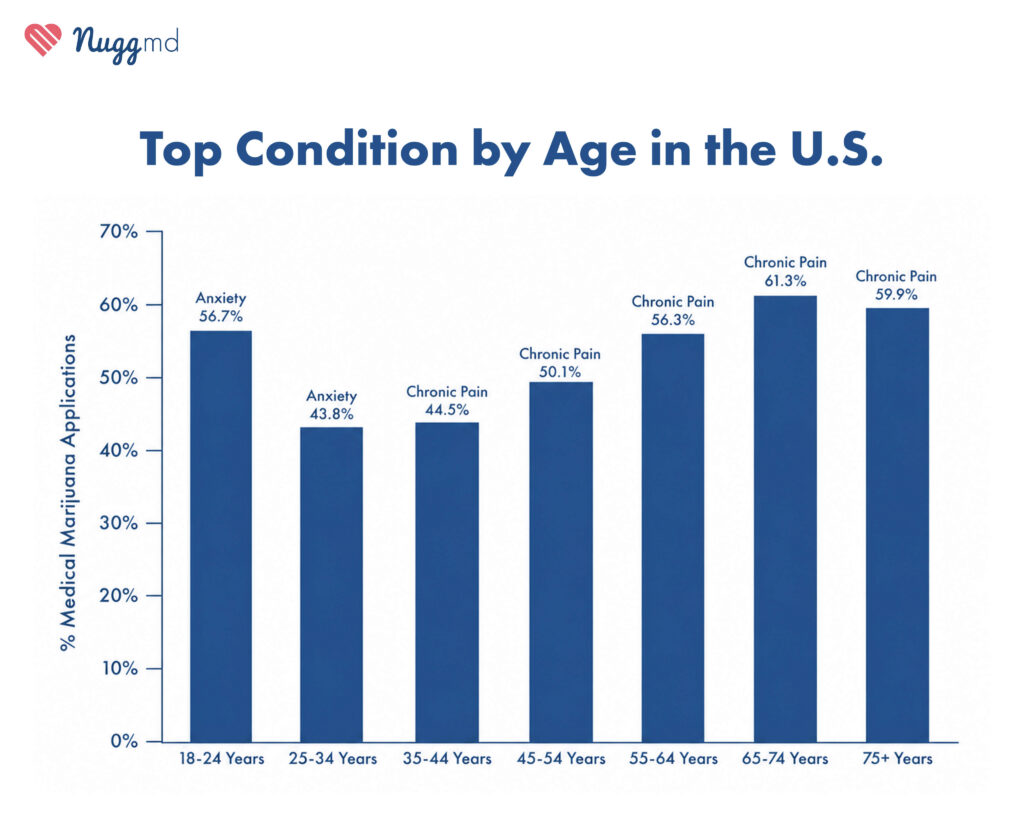
The dataset includes patients ages 18 to 103, with strong representation across all age groups.
While the population skews younger, each age range includes thousands of patients, allowing for meaningful comparisons across life stages.
Ages 18-24: Anxiety, Stress, & Insomnia
Younger patients are more likely to report mental health and symptom-driven conditions, with anxiety, stress, and insomnia among the most common. Nausea and migraines also appear frequently.
| Condition | Patients | % of Age Group |
| Anxiety | 20,964 | 56.7% |
| Stress | 13,876 | 37.5% |
| Insomnia | 8,642 | 23.4% |
| Migraines | 4,985 | 13.5% |
| Nausea | 3,912 | 10.6% |
Ages 25-34: Anxiety, Chronic Pain, & PTSD
Mental health remains prominent, but pain-related conditions begin to increase, alongside PTSD and migraines.
| Condition | Patients | % of Age Group |
| Anxiety | 6,214 | 43.8% |
| Chronic Pain | 4,982 | 35.1% |
| PTSD | 3,421 | 24.1% |
| Migraines | 2,118 | 14.9% |
| Insomnia | 2,006 | 14.1% |
Ages 35-44: Chronic Pain, Anxiety, & PTSD
Patients in this range show a strong mix of mental health and chronic pain, with more representation of long-term physical conditions.
| Condition | Patients | % of Age Group |
| Chronic Pain | 7,214 | 44.5% |
| Anxiety | 6,988 | 43.1% |
| PTSD | 4,112 | 25.4% |
| Insomnia | 3,562 | 22.0% |
| Muscle Spasms | 2,144 | 13.2% |
Ages 45-54: Chronic Pain, PTSD, & Anxiety
Chronic and neuropathic pain become more dominant, alongside PTSD and emerging serious medical conditions.
| Condition | Patients | % of Age Group |
| Chronic Pain | 5,988 | 50.1% |
| PTSD | 3,214 | 26.9% |
| Anxiety | 3,102 | 26.0% |
| Muscle Spasms | 2,098 | 17.6% |
| Cancer | 1,112 | 9.3% |
Ages 55-64: Chronic Pain, Neuropathy, & Cancer
This group is more heavily weighted toward chronic and condition-specific physical health concerns.
| Condition | Patients | % of Age Group |
| Chronic Pain | 4,912 | 56.3% |
| Neuropathy | 2,118 | 24.3% |
| Arthritis | 2,006 | 23.0% |
| Cancer | 1,284 | 14.7% |
| Glaucoma | 512 | 5.9% |
Ages 65-74: Chronic Pain, Arthritis, & Neuropathy
Older patients continue to report chronic pain and neurological conditions, with increased representation of age-related conditions.
| Condition | Patients | % of Age Group |
| Chronic Pain | 3,988 | 61.3% |
| Arthritis | 2,441 | 37.5% |
| Neuropathy | 1,884 | 28.9% |
| Cancer | 812 | 12.5% |
| Glaucoma | 418 | 6.4% |
Ages 75+: Chronic Pain, Arthritis, & Cancer
This group reflects serious and long-term medical needs, with a stronger concentration of chronic and neurological conditions than other age range groups.
| Condition | Patients | % of Age Group |
| Chronic Pain | 912 | 59.9% |
| Arthritis | 688 | 45.2% |
| Neuropathy | 388 | 25.5% |
| Cancer | 244 | 16.0% |
| Glaucoma | 198 | 13.0% |
How Conditions Vary by Age Range
Some patterns emerge when comparing conditions across age groups. Younger patients are far more likely to report mental health and symptom-driven concerns. Anxiety affects 56.7% of patients ages 18 to 24, alongside high rates of stress and insomnia. These conditions become less dominant with age, suggesting younger patients are more often and/or more comfortable seeking support for day-to-day mental health concerns.
As patients age, there is a steady shift toward chronic and condition-specific health needs. Chronic pain becomes increasingly prevalent, affecting over half of patients ages 45 and older. Conditions like neuropathy, arthritis, and glaucoma appear more consistently after age 50.
Conditions such as PTSD, migraines, and chronic pain persist across multiple age groups. These trends suggest that patients' needs evolve gradually over time.
Together, these trends show that age plays a meaningful role in the reasons why patients seek medical cannabis.
- Younger patients tend to prioritize mental health and symptom management.
- Older patients are more focused on long-term, chronic care.
These differences highlight the need for more tailored approaches across different life stages.
What This Means for Medical Cannabis Patients, Practitioners, and Legislators
These findings point to a gap between how medical cannabis is often positioned and how patients are actually using it. While much of the conversation still centers on a few familiar use cases, patient needs are far more varied.
Likewise, these needs shift with age. Younger patients are primarily seeking support for mental health and quality-of-life concerns. Older patients are more focused on managing chronic pain and long-term conditions. A single, uniform approach to care or product development is unlikely to serve both groups effectively.
The data suggests that patients are using cannabis as part of a broader approach to managing symptoms, rather than targeting a single diagnosis. More than half report multiple conditions. Many of the most common reported issues, including pain, nausea, and anxiety, can function as both standalone conditions and symptoms of other underlying health concerns.
This aligns with broader industry data showing that patients often use cannabis as an alternative to traditional treatments. A 2025 survey found that 8 in 10 consumers report using cannabis as a substitute for prescription drugs. This makes it difficult to fully capture patient intent within the constraints of current state reporting systems.
From a policy standpoint, this gap is difficult to ignore. Broad categories like chronic pain are widely accepted, but more specific and increasingly common conditions, such as neuropathy, are still excluded in many states. Research continues to explore cannabis as an alternative to traditional pain management, including opioid-based treatments. When policy lags behind both patient behavior and emerging research, patients are left to navigate those gaps on their own.
Taken together, these findings point to a need for more flexible and responsive frameworks across the industry. That includes:
- Expanding and standardizing qualifying criteria to better reflect real patient needs
- Improving how patient conditions are captured so symptom-driven use is better understood
- Developing products and clinical approaches that reflect the full range of conditions patients manage, not just the most commonly discussed ones
- Providing clearer messaging and more consistent product availability that can help patients find the right product and dosage that aligns with their wellness goals
Top Conditions by Region in the U.S.
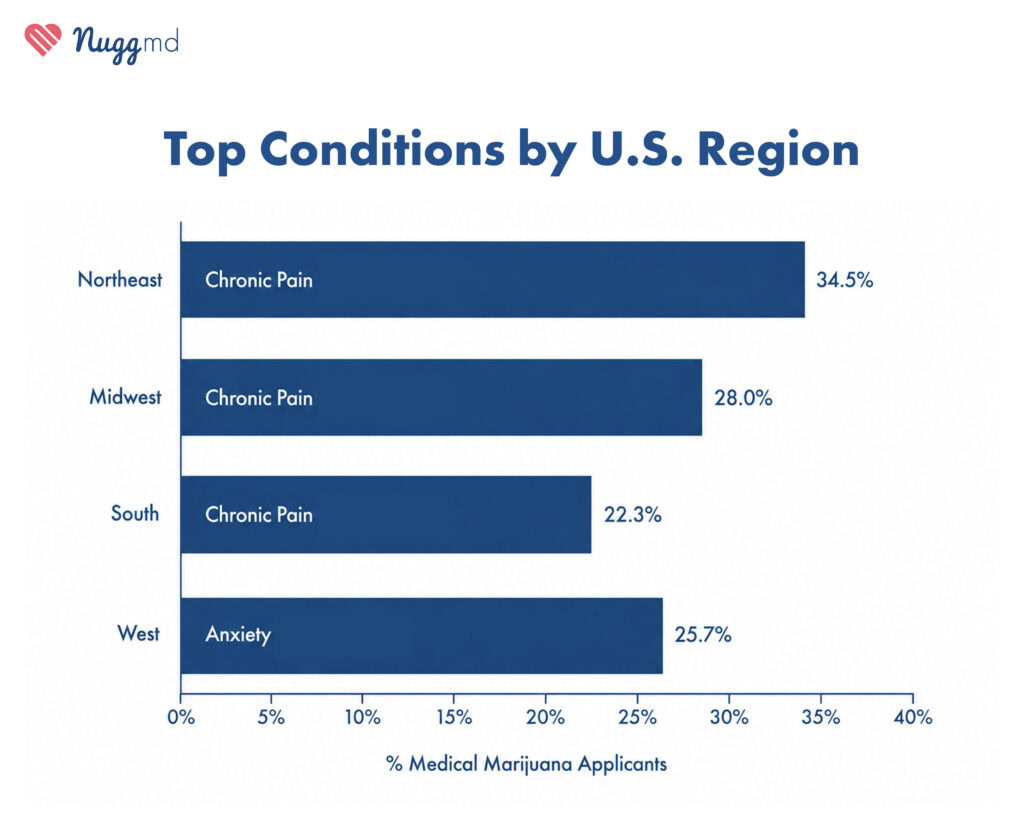
Regional differences highlight how patient needs and state-level policy shape why people seek medical cannabis.
We analyzed patient data across four U.S. regions using consistent groupings based on where NuggMD operates. While certain conditions appear across all regions, their relative prevalence varies significantly by geography.
| Region | Submissions | % of Total |
| West (Arizona, California, Montana, Nevada, Washington) | 45,947 | 47.81% |
| Northeast (Connecticut, Delaware, Maine, Maryland, Massachusetts, Michigan, Minnesota, New Jersey, New York, Pennsylvania, Vermont) | 23,861 | 24.83% |
| South (Florida, Georgia, Louisiana, Oklahoma, Texas, Virginia, West Virginia) | 17,525 | 18.24% |
| Midwest (Illinois, Iowa, Missouri, Ohio) | 8,767 | 9.12% |
Midwest & Northeast
In the Midwest and Northeast, chronic pain remains the dominant condition, affecting 34.45% and 27.99% of patients, respectively.
Both regions also show a notably high share of “Other” conditions, each accounting for roughly one in five patients. This suggests that many patients in these regions are either:
- Managing conditions that are not clearly captured by existing qualifying categories, or
- Defaulting to broader labels when more specific diagnoses are unavailable or unrecognized.
South
The South presents a more distributed profile.
While chronic pain (22.25%) remains the most common condition, anxiety (16.70%), stress (14.76%), and PTSD (10.65%) all appear at meaningful rates.
Compared to other regions, PTSD is more prominent here, and chronic pain appears less dominant. This may reflect differences in how patients report their conditions, as well as variation in qualifying condition frameworks across states.
West
The West stands apart from all other regions.
Anxiety (25.66%), stress (21.60%), and insomnia (15.09%) make up the majority of reported conditions.
Chronic pain (11.15%) appears at a lower rate than elsewhere.
This suggests a patient population that is more focused on mental health and quality-of-life concerns. Given that nearly half of all submissions come from California, this pattern likely reflects both broader access and more normalized use of cannabis for non-acute conditions.
All Regions
These regional patterns suggest that how patients report their conditions is shaped by what they experience and how states define and recognize those conditions.
The high prevalence of “Other” conditions in multiple regions reinforces that existing frameworks may not fully capture patient needs. As a result, regional data should be interpreted as both a reflection of health trends and of how accessible and well-defined medical cannabis programs are across different states.
| State | Top Conditions |
| AZ | Chronic Pain (72.23%), PTSD (15.17%), Other (2.88%), Anxiety (2.28%), Stress (2.12%) |
| CA | Anxiety (25.80%), Stress (22.39%), Insomnia (15.68%), Chronic Pain (10.31%), Migraines (7.12%) |
| CT | Stress (30.85%), Other (27.54%), Chronic Pain (22.77%), Neuropathic Pain (8.70%), Cancer (2.69%) |
| DE | Other (34.59%), Chronic Pain (30.83%), Stress (21.05%), Nausea (6.02%), Glaucoma (2.26%) |
| FL | Anxiety (19.42%), Insomnia (13.11%), Chronic Pain (11.17%), Stress (9.47%), Other (8.50%) |
| GA | PTSD (48.45%), Neuropathic Pain (14.01%), Cancer (6.60%), Other (6.20%), Anxiety (4.07%) |
| IL | Chronic Pain (33.12%), Migraines (23.64%), PTSD (19.01%), Stress (10.24%), Other (6.94%) |
| IA | Anxiety (15.20%), Stress (13.37%), Insomnia (10.33%), IBD (6.08%), Other (5.17%) |
| LA | PTSD (44.56%), Muscle Spasms (27.34%), Chronic Pain (6.49%), Other (5.12%), Anxiety (4.10%) |
| ME | Anxiety (25.00%), Stress (18.06%), Insomnia (15.28%), Chronic Pain (11.11%), PTSD (6.94%) |
| MD | Chronic Pain (50.62%), PTSD (21.14%), Muscle Spasms (10.12%), Nausea (9.39%), Other (3.16%) |
| MA | Anxiety (27.40%), Chronic Pain (21.33%), Stress (18.57%), Other (12.31%), Insomnia (8.72%) |
| MI | Chronic Pain (34.61%), Anxiety (18.38%), Stress (15.27%), Other (11.69%), PTSD (8.35%) |
| MN | Chronic Pain (31.80%), Anxiety (22.11%), Stress (16.59%), Other (12.29%), Migraines (7.42%) |
| MO | Chronic Pain (36.22%), Migraines (20.74%), PTSD (13.78%), Stress (9.76%), Other (8.54%) |
| MT | Chronic Pain (53.33%), PTSD (34.67%), Other (4.00%), Cancer (3.33%), Glaucoma (2.67%) |
| NV | Anxiety (36.86%), Chronic Pain (32.66%), Nausea (12.43%), Stress (7.85%), Other (5.09%) |
| NJ | Chronic Pain (41.86%), Anxiety (20.09%), Stress (13.91%), Other (10.58%), PTSD (6.36%) |
| NM | PTSD (54.35%), Chronic Pain (32.61%), Other (4.35%), Anxiety (2.17%), Stress (2.17%) |
| NY | Chronic Pain (29.72%), Anxiety (25.38%), Stress (17.84%), Other (13.66%), Insomnia (6.64%) |
| OH | Chronic Pain (31.92%), Anxiety (19.61%), Stress (15.88%), Other (13.25%), PTSD (9.41%) |
| OK | Anxiety (26.19%), Insomnia (16.09%), Chronic Pain (12.00%), Stress (11.69%), Migraines (7.78%) |
| PA | Chronic Pain (34.12%), Anxiety (21.64%), Stress (15.92%), Other (13.11%), PTSD (8.37%) |
| TX | PTSD (45.23%), Anxiety (19.14%), Stress (14.32%), Other (9.32%), Chronic Pain (6.59%) |
| VA | Anxiety (23.04%), Stress (18.11%), Chronic Pain (12.87%), Insomnia (12.74%), PTSD (6.19%) |
| WV | Neuropathic Pain (50.36%), PTSD (42.82%), Chronic Pain (3.02%), Other (2.01%), Cancer (1.21%) |
Key State-Level Takeaways
- Chronic pain is the leading condition in most states, but not all.
- PTSD dominates in several Southern and smaller states (GA, LA, NM, TX).
- The West, especially California and Nevada, is heavily driven by anxiety, stress, and insomnia.
- “Other” conditions appear consistently across states, reinforcing gaps in how patient needs are categorized.
- Some states show highly concentrated patterns, such as West Virginia (neuropathic pain + PTSD) and Arizona (chronic pain dominance).
How Conditions Vary by Region and State
Clear differences emerge when comparing conditions across regions and states, particularly in how patients report their needs.
- While chronic pain remains one of the most common conditions nationally, its prevalence varies significantly. It dominates in the Midwest (34.45%) and remains high in the Northeast and South, but drops sharply in the West (11.15%), where mental health and quality-of-life concerns are far more prominent.
At the state level, these differences become even more pronounced.
- Some states show highly concentrated patterns, such as Arizona, where chronic pain accounts for over 70% of reported conditions, and West Virginia, where neuropathic pain and PTSD together make up the majority of submissions.
- Others, like California and Nevada, are driven more by anxiety, stress, and insomnia. These variations suggest that patient behavior is not uniform and is influenced by both local health trends and how conditions are defined and reported within each state.
“Other” conditions also appear consistently across regions and states, often representing a significant share of submissions.
This reinforces the idea that many patients are either managing conditions not clearly captured by existing categories or defaulting to broader labels when more specific options are unavailable or unclear to patients.
These differences highlight that both geography and reporting structure play a meaningful role in how patient needs are represented in the data.
What This Means for Medical Cannabis Patients, Practitioners, and Legislators
These findings reinforce the role of a state’s list of qualifying conditions in shaping both patient access and the data itself. When certain conditions are not explicitly recognized, patients may be more likely to report symptoms or alternative diagnoses.
- For example, chronic pain does not appear as a top condition in every state. This could reflect differences in how states define qualifying conditions rather than actual differences in patient need.
- Similarly, anxiety appears as a leading condition in most regions. However, it's less prominent in areas where mental health conditions are not consistently included in the states’ lists of qualifying conditions.
The data also shows how demographic and regional skews can influence broader conclusions. With nearly half of all submissions coming from the West, driven largely by California, national trends are heavily influenced by a single region. This has downstream effects. If companies, policymakers, or researchers rely too heavily on aggregate data, they risk making decisions that reflect the needs of the most represented populations rather than the full patient base.
The wide variation across states suggests that certain patient groups may be underrepresented in the data altogether. Populations such as older adults, veterans, or patients with more complex or less commonly recognized conditions may be less likely to appear in large numbers, especially in states with more restrictive qualifying frameworks. This can create a feedback loop where unmet needs remain underrepresented, leading to fewer resources, less research, and limited access over time.
The data points to a need for more consistent, flexible, and inclusive approaches across the industry. Expanding qualifying conditions, improving how patient needs are captured, and accounting for regional and demographic differences would help ensure that medical cannabis programs better reflect the full range of patients they are intended to serve.
Putting Our Findings in Context
To better understand these patterns, we broke the above info down into a few major learnings based on how conditions vary by age, region, state, and more.
Patient Needs Don’t Fit Cleanly Into Existing Categories
One of the clearest patterns in this data is how often patient needs fall outside of predefined condition categories. “Other” conditions account for over 20% in both the Midwest and Northeast, suggesting that a meaningful portion of patients are either managing conditions not explicitly listed or are unable to find an appropriate category that reflects their experience.
This creates challenges across the board.
- For patients, it can lead to friction in accessing care that aligns with their needs.
- For practitioners, it limits the ability to identify clear patterns in how conditions present and overlap.
- And for policymakers and researchers, it introduces blind spots that can affect both decision-making and resource allocation.
Expanding and refining how conditions are defined and captured would provide a more accurate picture of patient needs and improve access to care.
Where Patients Live Shapes How They Access and Use Medical Cannabis
Where a patient lives has a clear impact on how they report and pursue medical cannabis. Chronic pain dominates in the Midwest (34.45%) and remains high in the Northeast and South, but drops sharply in the West (11.15%), where anxiety, stress, and insomnia make up the majority of reported conditions.
At the state level, patterns are even more extreme. Arizona is heavily concentrated in chronic pain, while West Virginia is driven by neuropathic pain and PTSD. In contrast, states like California and Nevada are more focused on mental health and quality-of-life concerns.
Policy and Data Are Closely Linked
State policies don’t just affect access to medical cannabis. They shape how patients report their conditions and how data is ultimately captured. When certain conditions are not explicitly recognized, patients may be more likely to select broader categories or report symptoms instead.
This shows up in the data. Chronic pain is a leading condition in most states, but not all. In some cases, this appears to reflect how states define qualifying conditions rather than differences in patient need. Similarly, mental health conditions are more prominent in regions and states where they are more clearly recognized.
This creates a challenge for interpreting trends. What looks like variation in patient needs may instead reflect variation in policy. As a result, improving consistency across states would not only expand access, but also lead to more accurate and comparable data.
Further Study Is Needed
While this dataset offers valuable insight, it has limitations. A large share of submissions comes from the West, particularly California, and the population skews younger. This can influence both national and regional trends.
This data also reflects only patients using the NuggMD platform. It does not include those seeking care in person or those without access to medical cannabis or who choose to self-medicate through their state’s adult-use cannabis programs, which may lead to different patterns not captured here.
Additionally, many patients report multiple conditions or select “Other,” making it harder to fully understand patient needs. This highlights the need for more consistent and comprehensive data collection.
Further research with broader geographic representation and more balanced demographics will be critical to building a clearer picture of how patients use medical cannabis.
Benefits of Talking to Your Doctor
With patients reporting a wide range of conditions, and many selecting multiple or “Other,” it’s clear that medical cannabis use is not one-size-fits-all. Speaking with a qualified doctor can help patients better understand their condition and whether cannabis is an appropriate option as part of their care.
A healthcare provider can also help guide decisions around product type, dosing, and potential interactions with other medications. Because cannabis can affect individuals differently, this kind of personalized guidance is especially important for using it safely and effectively.

Dosing Considerations
Dosing with medical cannabis can vary widely depending on the individual, the product, and the condition being treated. Factors such as age, tolerance, metabolism, and consumption method can all influence how cannabis affects the body.
Because of this variability, starting with a lower dose and adjusting gradually under medical guidance is often recommended. Understanding how different cannabinoids and product types work can help patients find an approach that is both effective and safe.
Conclusion
This report highlights how and why patients are seeking medical cannabis today, and how those needs vary across age, region, and state. While certain conditions remain consistent drivers, patient experiences are more varied than a single narrative can capture.
Gaps in condition categories, regional differences in qualifying conditions and how cannabis is discussed, and uneven access continue to shape both patient care and the data itself. These limitations reinforce the need for more comprehensive research and more consistent frameworks across states.
As more information becomes available, patients, practitioners, policymakers, and stakeholders will be better equipped to make informed decisions. Until then, this report should serve as a starting point for understanding the continuously evolving role of medical cannabis in patient care.
The information in this article and any included images or charts are for educational purposes only. This information is neither a substitute for, nor does it replace, professional legal advice or medical advice, diagnosis, or treatment. If you have any concerns or questions about laws, regulations, or your health, you should always consult with an attorney, physician or other licensed professional.