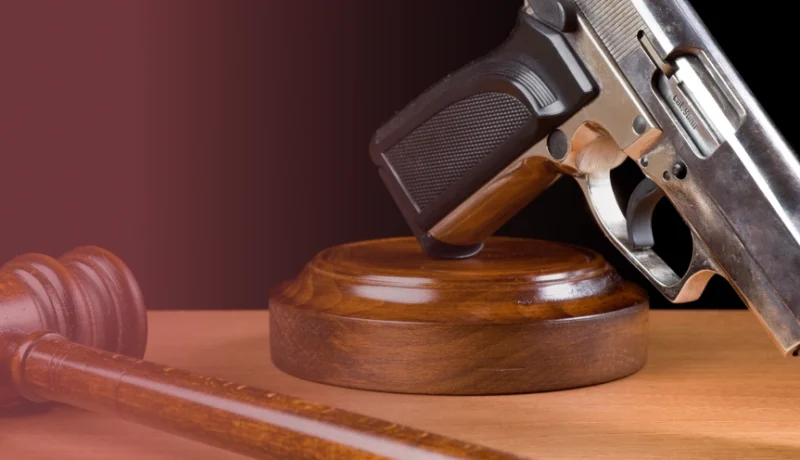
The U.S. Supreme Court ruled on Thursday that a Texas cannabis consumer cannot be prosecuted for possessing a firearm in a decision that affirms the Second Amendment rights of most cannabis users.
The ruling bars the federal government from prosecuting Ali Hemani, a Texas man whose home was raided by federal law enforcement officers in 2022. A search of the home yielded a handgun and about 60 grams of cannabis, which Hemani acknowledged he used “about every other day,” according to a report from the Washington Post.
Federal prosecutors subsequently charged Hemani under provisions of the Gun Control Act of 1968, which prohibit “unlawful users” of controlled substances from possessing firearms. Lower courts dismissed the criminal charges, ruling that they violated Hemani’s Second Amendment right to bear arms. Federal prosecutors appealed those rulings, sending the case to the Supreme Court.

Unanimous Decision Preserves Cannabis Consumers’ Constitutional Rights
In a unanimous decision, Justice Neil M. Gorsuch wrote that the law as applied in the case violated Hemani’s constitutional right to bear arms.
“We appreciate that drugs and guns can sometimes make for a dangerous mix,” Gorsuch wrote. But he noted the prosecution of Hemani was not consistent with the court’s standard that restrictions on firearms must be based on the nation’s “tradition.”
“And, apart from pointing to habitual drunkard laws, the government has not even attempted to prove that any other specific historical principle might justify its prosecution in this case,” Gorsuch wrote.
“[The federal government] asks us to conclude that anyone who regularly uses marijuana is categorically violent and dangerous without any further showing,” the majority opinion cited by NORML maintains, adding, “the government maintains that it may automatically strip Mr. Hemani of his Second Amendment right to possess a firearm because he uses marijuana a few times a week. More than that, because he possessed a gun despite this prohibition, the government insists it may imprison him for up to 15 years and disarm him for life. … All based on little more than its current say-so, one at odds with its own regulatory actions. Affording the government that kind of ‘broad power to designate any group as dangerous and thereby disqualify its members from having a gun’ would risk allowing it to ‘quickly swallow’ the Second Amendment.”
Attorneys for the Justice Department argued that the law is consistent with a 2022 Supreme Court decision that ruled that restrictions on firearms must be consistent with the “nation’s historical tradition.” The government cited laws that date back to the founding of the country that barred “habitual drunkards” from possessing guns.
The court disagreed, writing that the government’s argument “misapprehends” the purpose of those laws, which “targeted different kinds of people, did so for different reasons, and operated in different ways.”
“By their own terms, laws like these did not seek to protect the public from violence so much as to protect habitual drunkards from themselves and their families from financial devastation,” the decision reads.
Gorsuch noted that the court’s decision does not preclude the government from banning drug “addicts” or “those presently intoxicated” from possessing firearms. Prosecutors would be free to file charges if they had “proof that the defendant’s use of marijuana (or any other drug) renders him a danger to himself or others.”
Advocates Cheer Supreme Court’s Decision
The Supreme Court’s decision was swiftly hailed by cannabis policy reform advocates and civil rights activists. Joseph A. Bondy, board chair of the National Organization for the Reform of Marijuana Laws and co-counsel of record for NORML’s amicus filing in the case, applauded the court’s ruling.
“Today’s decision is a measured but important vindication of personal freedom and constitutional principle,” he said. “The Court recognized what NORML urged: that responsible adults do not forfeit their Second Amendment rights merely because they consume cannabis, absent any individualized showing of dangerousness. Our Constitution protects people, not stereotypes, and it does not permit the government to convert cannabis use alone into a categorical mark of civic unworthiness.”
“The court has sent a strong message that the government cannot criminalize the conduct of large numbers of people by making categorical and unfounded assumptions about whether they are dangerous,” said Cecillia Wang, legal director at the ACLU, according to a report from the Associated Press.
Catch up on the latest cannabis news and sign up for NuggMD's Weekly Sesh newsletter for the latest consumer tips, industry updates, and product recommendations.
The information in this article and any included images or charts are for educational purposes only. This information is neither a substitute for, nor does it replace, professional legal advice or medical advice, diagnosis, or treatment. If you have any concerns or questions about laws, regulations, or your health, you should always consult with an attorney, physician or other licensed professional.