
Key Takeaways About Cannabis Delivery
- Cannabis delivery allows consumers to shop their local dispensary and have products delivered to their door.
- Delivery is only available in select states for both recreational and medical purposes; others only allow medical. Some states don’t permit delivery at all.
- Delivery is permitted in-state. Shipping through the mail or a private carrier is different and not allowed anywhere.
Cannabis delivery has grown into one of the most accessible ways to buy regulated products, offering a familiar online ordering experience with rules tailored to each state’s cannabis program. Customers browse licensed menus, verify their age, place an order, and receive their products at home from drivers who meet strict compliance requirements.
Delivery availability varies widely across the country, and medical and recreational customers often face different limits, taxes, and eligibility rules. Understanding how delivery works, where it’s allowed, and how it differs from shipping helps consumers navigate the system with confidence.

How Cannabis Delivery Works
Cannabis delivery operates through a structured process that meets state regulatory requirements. Customers begin by browsing a licensed retailer’s online menu, where products are usually listed with testing information, potency details, and real‑time availability tied to the state’s inventory system.
Before placing an order, customers create an account and verify their age. States require identity checks both during online checkout and upon the driver's arrival. The customer must be present at the delivery address and show a valid government‑issued ID at the door.
Once the order is confirmed, the retailer assigns a driver who follows strict transport and handoff rules. Drivers carry only the products scheduled for delivery, keep them sealed in approved packaging, and maintain required logs or tracking data. At the door, the driver verifies the customer’s identity, completes the transaction, and records the delivery information for entry in the state’s tracking system.
Payment options depend on state rules and retailer capabilities. Because cannabis remains federally illegal, credit card processing is uncommon, though ongoing federal reform efforts could eventually change how payment services approach the industry. Most deliveries rely on cash, debit, or bank‑linked payment apps approved for cannabis transactions. Delivery windows vary by region, with dense urban areas often offering same‑day service and rural areas facing longer wait times or limited availability.
Where Cannabis Delivery Is Available
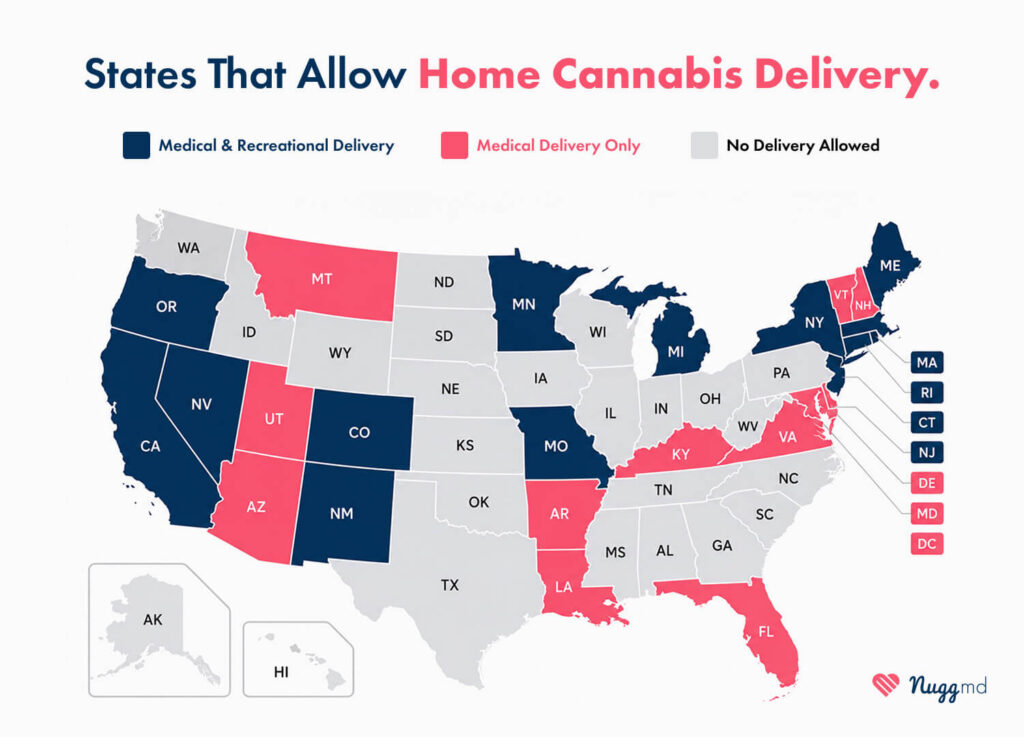
Cannabis delivery laws vary widely across the United States, and each state sets its own rules on whether retailers can deliver products directly to consumers. Several states with adult‑use programs permit recreational delivery, including:
- California
- Colorado
- Connecticut
- Maine
- Massachusetts
- Michigan
- Minnesota
- Missouri
- Nevada
- New Jersey
- New Mexico
- New York
- Oregon
- Rhode Island
In all of these states, delivery is available to both adult‑use consumers and registered medical patients, allowing licensed operators to serve the full market under defined compliance frameworks.
Medical delivery is also permitted in several states that authorize home access for registered patients, like:
- Arizona
- Arkansas
- Delaware
- The District of Columbia
- Florida
- Kentucky
- Louisiana
- Maryland
- Montana
- New Hampshire
- Utah
- Vermont
- Virginia
Local rules continue to shape availability. Even in states that permit delivery, municipalities may choose to limit or prohibit it, creating uneven access across regions. Delivery availability can differ significantly between urban and rural areas, depending on local regulations and the number of licensed operators.
Research published in the American Journal of Public Health highlights how these differences affect access. Delivery can reduce geographic barriers for people who live far from licensed retailers, residents of rural communities, and individuals with mobility limitations. States that allow delivery tend to offer more consistent access to regulated products, while states that restrict it often reinforce existing disparities.1
Because cannabis remains regulated at the state level, delivery rules continue to evolve as programs expand and policymakers evaluate how delivery affects access, safety, and public health.
Differences for Medical and Recreational Customers

Medical and recreational customers experience delivery differently because each state sets its own eligibility rules, verification requirements, and product limits. In states with adult‑use delivery, both medical patients and adult‑use consumers can receive cannabis at home, but medical patients often have access to a broader range of products, higher purchase limits, or tax advantages, depending on the state’s program structure.
In states that permit only medical delivery, access is limited to registered patients who meet the state’s medical program requirements. These programs typically require patient verification at the time of delivery and may restrict the types of products that can be transported. Some states also set different packaging or labeling rules for medical deliveries.
The AJPH study notes that delivery can play a meaningful role in medical access, particularly for patients with mobility limitations or those who live far from licensed dispensaries.1 Recreational delivery expands access for the broader adult population, but medical delivery remains especially important for individuals who rely on cannabis for symptom management and cannot easily travel.
Federal law continues to draw a sharp distinction between delivery and shipping. Medical and recreational customers alike can receive cannabis through state‑regulated delivery services, but neither group can legally have cannabis shipped through the mail or private carriers. This distinction shapes how consumers access products and reinforces the importance of state‑regulated delivery systems for both markets.
Can You Get Cannabis Shipped?
Cannabis delivery and cannabis shipping operate under very different legal frameworks. Delivery is regulated at the state level, and licensed operators in certain states can bring cannabis directly to consumers. Shipping, however, is generally governed by federal law, and cannabis cannot be mailed or shipped via carriers operating under federal jurisdiction.
The United States Postal Service does not allow cannabis shipments, and private carriers such as UPS and FedEx maintain similar policies. These companies prohibit the shipment of cannabis regardless of whether it is legal in the sender’s or recipient’s state. As a result, consumers cannot legally receive cannabis through the mail or through private shipping services.
Hemp and CBD products are treated differently, but only when they meet federal definitions. Hemp products containing no more than 0.3% THC can be shipped if they comply with federal rules and carrier requirements. Products that exceed this threshold, or products containing intoxicating cannabinoids such as delta‑8 or THCA flower, are often restricted or prohibited by carriers even when state law permits their sale.
Pending federal reforms could eventually reshape the regulatory landscape for shipping cannabis. Changes to federal cannabis policy, including proposals to revise how cannabis is treated under federal law, may influence how carriers handle cannabis products in the future. For now, though, state‑regulated delivery remains the only lawful way to have cannabis brought directly to a residence.
Why Delivery Matters

Cannabis delivery plays a significant role in how people access regulated products, especially in states where storefronts are unevenly distributed or difficult to reach. Cannabis delivery can reduce geographic barriers for individuals who live far from licensed retailers, residents of rural communities, and people with mobility limitations. In these situations, delivery offers a practical way to obtain regulated cannabis without traveling long distances or relying on transportation that may not be readily available.
Delivery also helps address disparities created by local opt‑outs. In states where municipalities can prohibit storefronts, delivery provides a pathway for consumers to access regulated products even when their city or county does not allow dispensaries. This can reduce reliance on unregulated markets and improve access to tested, labeled products.
For medical patients, delivery can be especially important. Patients who rely on cannabis for symptom management may face challenges traveling to dispensaries, and delivery offers a consistent way to obtain the products they need. In states with both medical and adult‑use delivery, patients benefit from the same home‑access options available to recreational consumers, often with program‑specific advantages such as higher purchase limits, lower taxes, or access to certain product categories.
Delivery also matters because shipping remains prohibited under federal law. Consumers cannot legally receive cannabis through the mail or through private carriers, which makes state‑regulated delivery the only lawful way to have cannabis brought directly to a residence. Pending federal reforms could eventually reshape how cannabis is handled by carriers, but until those changes occur, delivery remains central to how both medical and adult‑use consumers access regulated products.
A Changing Landscape
Cannabis delivery continues to evolve as states refine their programs and expand access for both medical patients and adult‑use consumers.
Delivery now plays a central role in how people obtain regulated products, especially in areas with limited storefronts or difficult access. Shipping remains prohibited under federal law, but ongoing reform proposals could eventually reshape how cannabis moves across state lines and through national carriers.
Until those changes occur, delivery will remain the primary way consumers receive cannabis at home, and its importance will grow as more states consider how to modernize their access models.
References
- Ebling T, Azagba S, Hall M, Jensen JK. US State Recreational and Medical Cannabis Delivery Laws, 2024. American Journal of Public Health. Published online November 14, 2024:e1-e13. doi:https://doi.org/10.2105/ajph.2024.307874 ↩︎
The information in this article and any included images or charts are for educational purposes only. This information is neither a substitute for, nor does it replace, professional legal advice or medical advice, diagnosis, or treatment. If you have any concerns or questions about laws, regulations, or your health, you should always consult with an attorney, physician or other licensed professional.